CWL genome
Write what the app is so a person can audit it. Holes stay labeled — never hidden guesses.
AgenticOps
agenticop.io
CWL tip 1.0.26 · now public
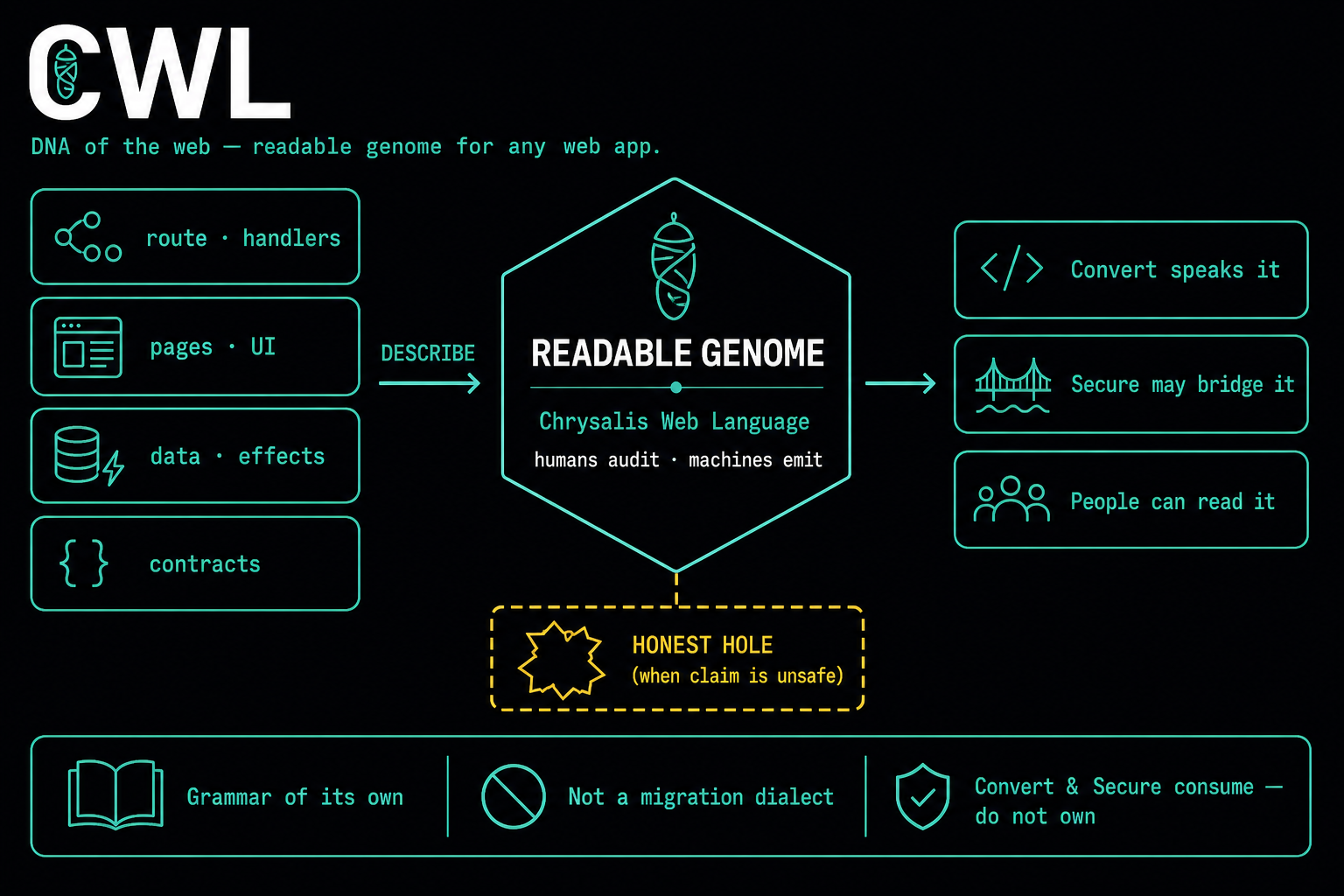
Chrysalis Web Language describes what an app is — routes, pages, data, UI, effects — and honest holes when a claim is unsafe. Convert and Secure consume it — they do not redefine it.
Pillar 01 · language
The genome matures on its own so migration deadlines and firewall rollouts do not fork the language. Tip 1.0.26 — HTML shell preserve, urlencoded forms, gold fixtures, DNA-bridge contracts.
Readable app genome
Routes, handlers, effects, honest holes — Rosetta meaning Convert and Secure both consume.
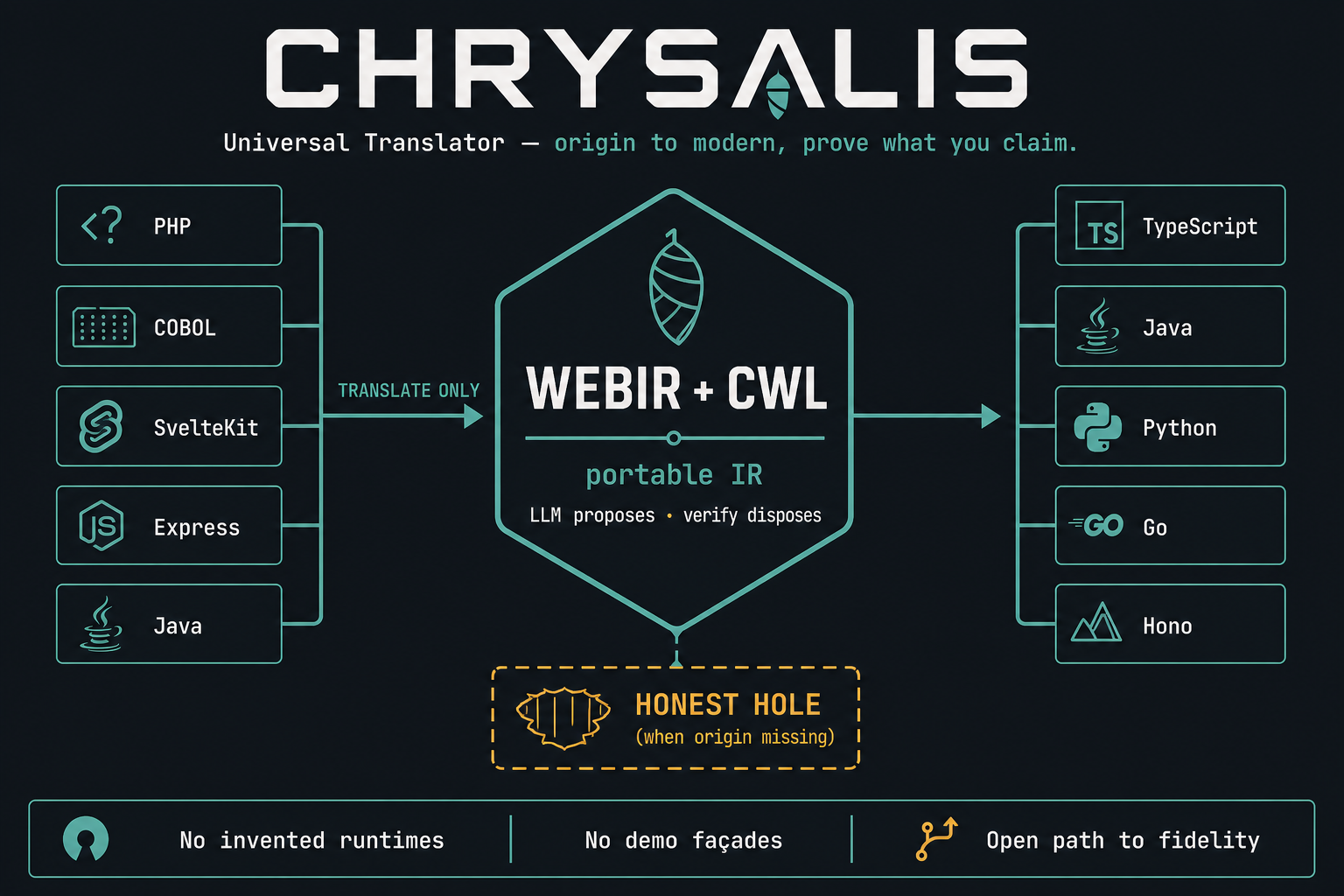
02 · ConvertOrigin → WebIR/CWL → emit
Peel once, emit many. Languages in, modern out — see the full diagram below.
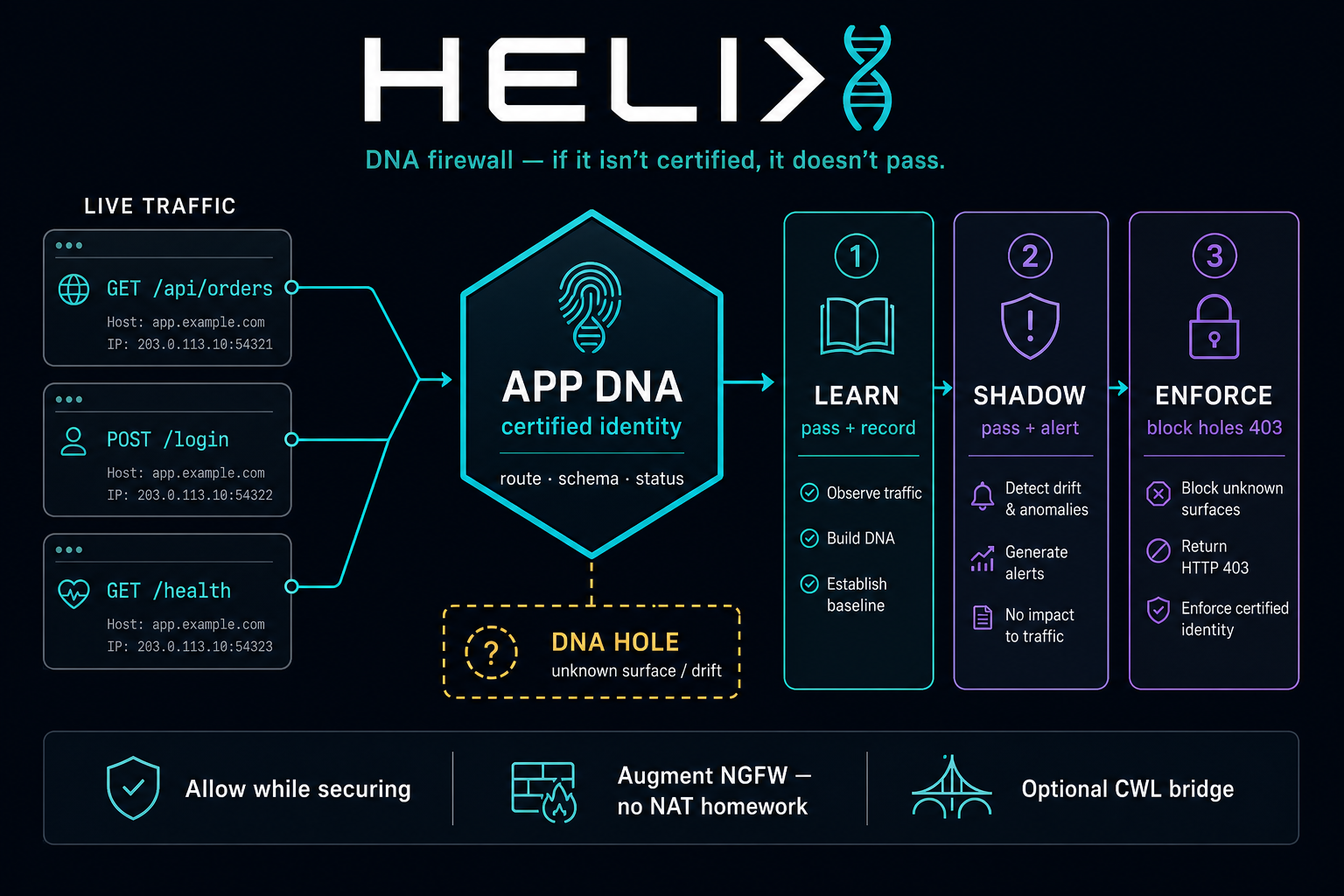
03 · SecureTrust nothing until certified
Learn → promote → shadow → enforce from traffic DNA. Optional CWL bridge.
Open source
CWL leads. Convert and Secure are public consumers of the same tip — 1.0.26. Apache-2.0.
Read deeper
Technical papers (CWL, WebIR, Convert, Helix, traffic bar) plus every public project — WPTP, FDE, Ghost Museum, Lane/MSP — with attribution where required.
See it
CWL is the readable genome. Convert is the language map. Helix is the traffic enforce loop.
What we actually do
Write what the app is so a person can audit it. Holes stay labeled — never hidden guesses.
Peel any origin into WebIR/CWL once. Emit modern targets from the same DNA — not N×M one-offs.
Helix learns and enforces from live identity. AI can draft — recorded traffic says ship or stop.
Chrysalis is open source as three public pillars — CWL, Convert, Secure. AgenticOps runs the practice with your team. wisptools.io is a separate product we still operate — proof we ship, kept apart so names don’t blur.
Where AI actually fits in
We use agents throughout — we don’t ask you to trust them on faith.
AI proposes
Agents read origin code, draft CWL, emit candidates, and flag uncertainty — every step logged.
Intelligence Shorthand
Proven patterns get saved. Next hit looks them up — faster, cheaper, no new untested risk.
Replay real traffic
Recorded requests and effects must match. If they don’t, it doesn’t ship — human or AI authored.
Read more
Same idea, more detail — pick what’s relevant.
Readable genome — tip 1.0.26 public. Convert and Secure consume; they do not own.
Open → 01What a project with us actually looks like, step by step.
Open → 02How the process works in order — from recording traffic to rolling out safely.
Open → 03Real, working examples — plus a live product we built and still run.
Open → 04Live projects and hostnames — Translation Hub, FDE, corporate site.
Open → 05The rules we won't break, and why they matter.
Open → 06Why we started building this, and where it's headed.
Open → →Tell us about your stack — we'll tell you honestly if this fits.
Open →