Routes
Which URLs and methods the app is allowed to expose — new paths are holes until promoted.
Pillar 03 · Secure · Helix
Helix asks one question: is this still the certified app? Learn, promote, shadow, then enforce from live traffic DNA. Allow while securing.
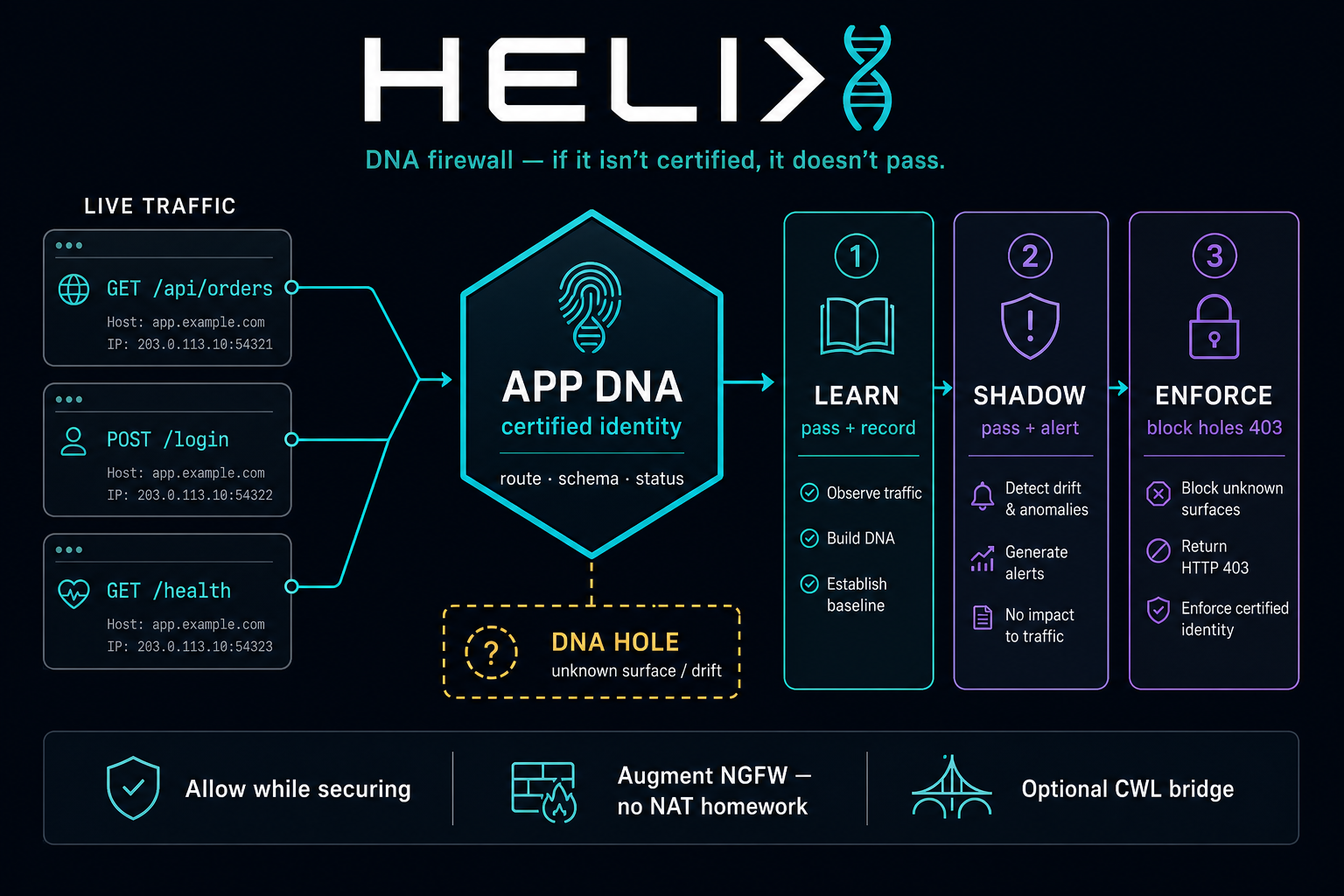
How Helix runs
Modes separate pass from trust. You never flip from “open internet” to “locked” in one scary click.
Observe real requests and responses. Build app-dna from what the app actually does.
Diff the certificate. Promote only what you intend. Reload without downtime.
Live traffic vs certified DNA. Holes alert only — users keep working.
Unauthorized surface stops. We don’t allow app shape we didn’t certify.
What DNA fingerprints
Which URLs and methods the app is allowed to expose — new paths are holes until promoted.
Shape of bodies and query strings that belong to certified routes — drift shows up as identity failure.
Expected response patterns for the certified surface — what “normal” looks like for that route.
A DNA hole means Helix saw app shape it never certified (unknown route, schema drift, and so on). It is about identity, not scanning every payload for classic web attacks.
Where Helix sits
Internet clients hit Helix on the public port. Helix talks to your app on localhost. Your existing NGFW / NAT stays put — Helix is the identity layer in front of the process.
Operators call this Mode A: same box, public listener moves to Helix, app binds loopback. You keep allowing traffic while Helix learns, shadows, then enforces.
What Helix does
Helix watches real traffic, learns what your app normally does, then blocks new routes and shapes that were never part of that picture. You turn it on without CWL or Convert.
Chrysalis Web Language is a separate pillar for describing and translating apps. Helix does not need it to protect. If you later want a migration’s claimed surface checked against live traffic, that is when CWL can connect — not before.